

 Tiếng Việt
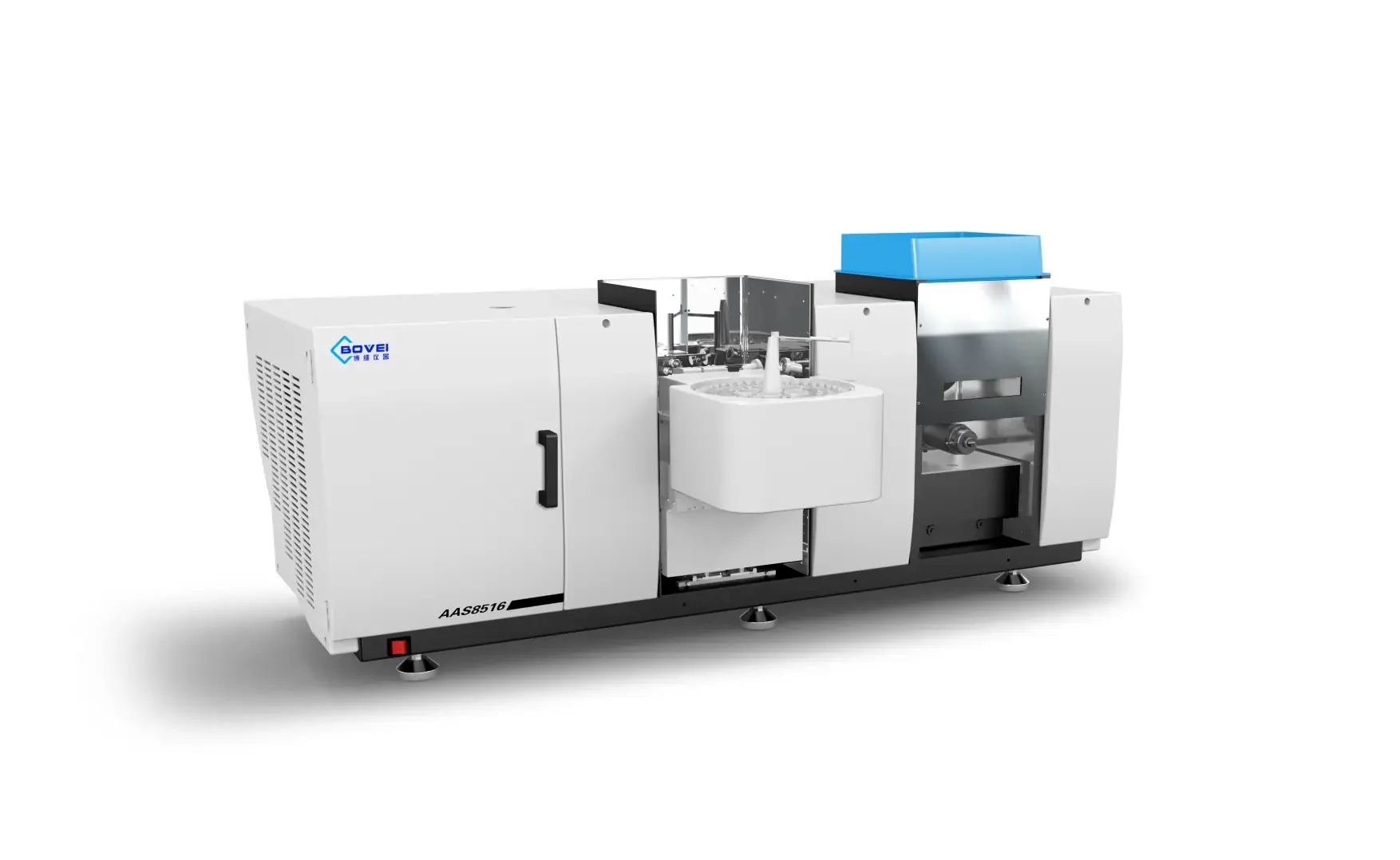
AAS 8516 – Atomic Absorption Spectrophotometer
Learn all about the atomic absorption spectrophotometer (AAS), from its structure and working principle to practical applications in environmental, food, and medical testing.
Product Information
What is an Atomic Absorption Spectrophotometer? Applications and Classification
In modern chemical analysis laboratories, determining trace levels of toxic heavy metals is crucial. To perform this task with the highest precision, the atomic absorption spectrophotometer (AAS) is the leading device trusted by experts worldwide. What is the structure of this device, and how is it applied? Let us explore it in detail in the following article.
1. What is an Atomic Absorption Spectrophotometer?
An atomic absorption spectrophotometer (AAS) is a physical-chemical analytical instrument used to quantify metallic and semi-metallic elements based on the principle of light absorption.
When a beam of light with a specific characteristic wavelength passes through a cloud of free atoms in their ground state, these atoms absorb the light energy. The measured light absorbance is directly proportional to the concentration of the element in the sample, according to the Beer-Lambert law. This allows technicians to determine the exact metal content, even at extremely low concentrations.
2. Basic Structure of an AAS Device
A standard atomic absorption spectrophotometer system consists of the following primary components:
- Characteristic Radiation Source (HCL or EDL Lamp): Emits a light beam at the precise wavelength of the target element to be measured.
- Atomization System: Responsible for converting the sample from a liquid solution into a free atomic vapor. This component typically utilizes either flame or graphite furnace techniques.
- Monochromator System: Isolates and selects the correct characteristic wavelength for measurement, eliminating background noise and unwanted light rays.
- Detector: Receives the light signal and converts it into an electrical signal for computer data processing.
3. Common Atomization Methods
Today, the atomic absorption spectrophotometer models available on the market usually integrate one or both of the following atomization methods:
Flame Atomic Absorption Spectrometry (F-AAS)
This method uses a gas mixture (typically Air-Acetylene) to burn and vaporize the sample at temperatures ranging from 2000°C to 3000°C. The advantages of F-AAS include low operating costs, fast analysis speed, and high repeatability, making it suitable for parts-per-million (ppm) concentration levels.
Graphite Furnace Atomic Absorption Spectrometry (GF-AAS)
The sample is injected into a graphite tube and heated electrothermally according to a strict temperature program. This method possesses ultra-high sensitivity (reaching parts-per-billion or ppb levels), allowing for the analysis of ultra-trace elements with tiny sample volumes (only a few microliters).
4. Practical Applications of AAS
Thanks to its exceptional accuracy and sensitivity, the atomic absorption spectrophotometer is widely used in various fields:
- Environmental Testing: Monitoring toxic heavy metal contents such as Lead (Pb), Cadmium (Cd), Mercury (Hg), and Arsenic (As) in drinking water, soil, and industrial wastewater.
- Food Safety and Pharmaceuticals: Checking the limits of inorganic impurities in agricultural products, seafood, dairy products, and traditional or western medicines.
- Geology and Mining: Determining the concentration of gold, silver, copper, and other precious metals in mineral ores.
- Clinical Medicine: Analyzing trace elements in blood, hair, or biological tissues for research and diagnostic purposes.
Be the first to review “AAS 8516 – Atomic Absorption Spectrophotometer”
Related products

ANALYSIS INSTRUMENT

ANALYSIS INSTRUMENT
ANALYSIS INSTRUMENT
ANALYSIS INSTRUMENT

ANALYSIS INSTRUMENT

ANALYSIS INSTRUMENT
ANALYSIS INSTRUMENT

ANALYSIS INSTRUMENT







Reviews
There are no reviews yet.