

 Tiếng Việt
User manual
Comprehensive Review of DFAIC Elemental Analyzers: Which Solution Best Optimizes Your Cost?
10
Sep
Sep
Comprehensive Review of DFAIC Elemental Analyzers: Which Solution Best Optimizes Your Cost?
In modern industrial manufacturing, strict quality control of raw materials and finished products directly determines a company’s competitiveness. To solve this efficiency puzzle, the dfaic elemental analyzer has emerged as a groundbreaking technological solution, helping laboratories and factories radically optimize their operational costs.
As the authorized distributor of DFAIC in Vietnam, Maxlab Equipment Company is proud to import these devices directly, offering genuine factory warranties and specialized technical services. This article delivers an objective, in-depth analysis of DFAIC’s Energy Dispersive X-ray Fluorescence (ED-XRF) and Laser-Induced Breakdown Spectroscopy (LIBS) product lines. Through this guide, Maxlab will help you easily identify the ideal equipment configuration for your budget and specific industry needs.
1. Why Do DFAIC Analytical Technologies Maximize Cost Optimization?
Traditionally, checking the quantitative or qualitative composition of chemical elements required expensive wet chemistry methods or massive WDXRF (Wavelength Dispersive X-ray Fluorescence) systems with exorbitant capital costs. The introduction of the dfaic elemental analyzer line utilizing ED-XRF technology distributed by Maxlab has completely shifted the paradigm through exceptional economic benefits:
- Non-Destructive Testing (NDT): Preserves the complete integrity of the original sample, entirely eliminating the cost of losing valuable raw materials.
- Minimal Sample Preparation: Reduces the need for complex auxiliary chemicals, shortening technician handling time to just a few minutes.
- Rapid High-Throughput Analysis: Delivers simultaneous multi-element results across a wide range in seconds or minutes, preventing production line bottlenecks.
- Low Cost of Ownership: The initial purchase price, system installation, and routine maintenance are significantly more affordable than bulky WDXRF setups.
2. Detailed Review of DFAIC Benchtop XRF Analyzers (Fixed Laboratory Systems)
DFAIC’s benchtop systems, currently fully supplied by Maxlab, are divided into distinct segments tailored to basic analytical needs or advanced smart automation for unattended overnight operations.
DFAIC Lab Series ──┬── Economy: DF-1000E (1 sample position, Na-U)
                   ├── Universal: DF-1000 / DF-1500 (Top-down illumination)
                   └── Premium/High-end: DF-1600 / DF-1800 (100W, Robotic automation)
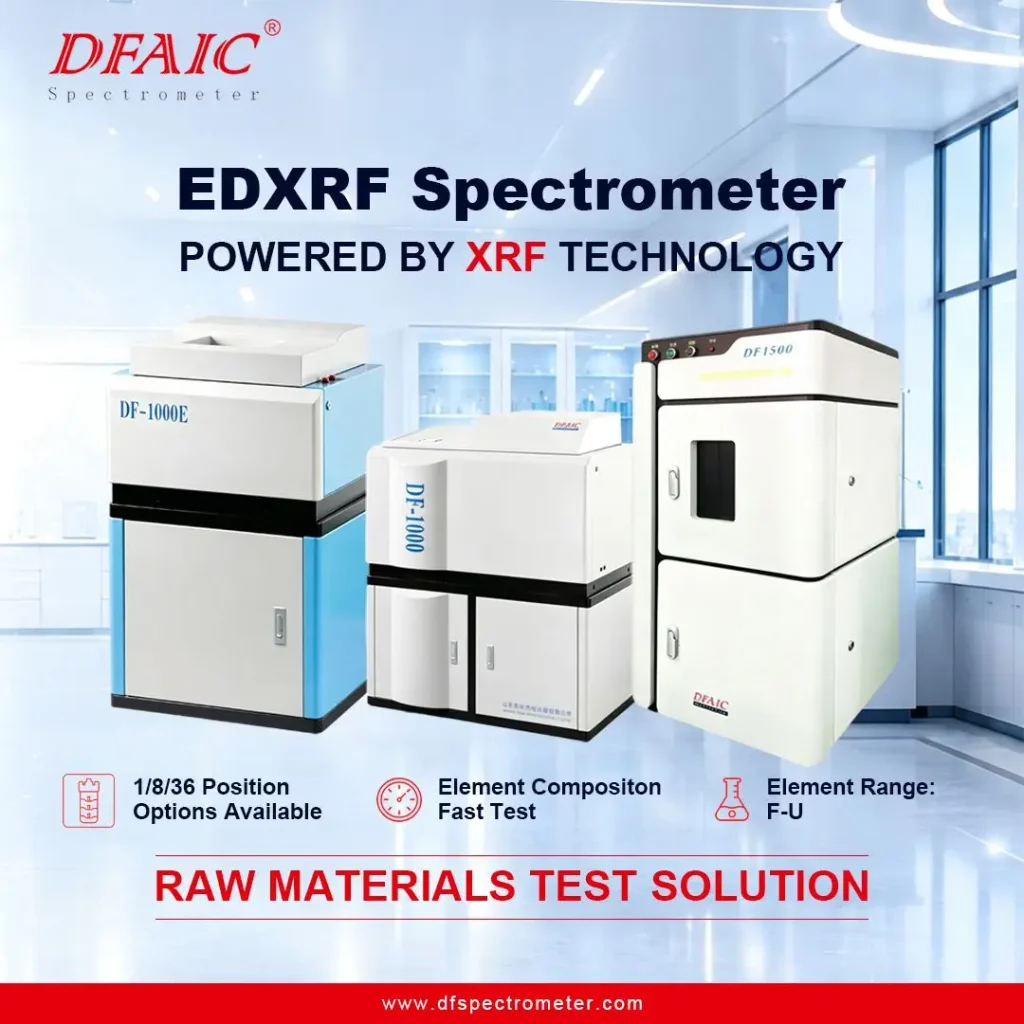
2.1. DFAIC DF-1000E (Economy Type) – The Budget Solution for the Silica Sand Industry
If your business operates in mining, processing quartz, or silica sand, the DF-1000E is the ultimate answer to your budget constraints.
- Core Characteristics: This machine is engineered specifically as a dedicated tool for the silica sand industry. Featuring a single 1-sample position, it simplifies operation to a simple “one-click” process to yield results.
- Analytical Capability: Covers elements from Sodium (Na) to Uranium (U) with a sensitive detection limit spanning 1ppm to 99.99%.
- Cost Optimization Benefits: The system utilizes highly reusable reference standards, drastically minimizing daily consumable costs for the laboratory.
2.2. DFAIC DF-1000 & DF-1500 – Absolute Protection for the Refractories Industry
A fatal flaw of many conventional XRF machines is sample dust falling into and damaging the delicate detector window. To eliminate this issue, DFAIC equips both the DF-1000 and DF-1500 models with an intelligent architectural philosophy:
- Top-Down Illumination Design: The X-ray source and detector are positioned above the sample chamber. Consequently, falling powder or dust from refractory materials and minerals cannot contaminate the detector window, multiplying the lifespan of core components.
- Sample Tray Variations:
- DF-1000 (Universal Type): Features an 8-position automatic sample loader that lets you queue multiple samples simultaneously, eliminating waiting times and extending analysis from Fluorine (F) to U.
- DF-1500 (Classic Type): Employs a traditional 1-sample position layout covering Na-U, but offers the flexibility to configure the detector with either US or German brands based on your financial plan.
2.3. DFAIC DF-1600 & DF-1800 – The Pinnacle of High-Power Robotic Automation
For large-scale cement manufacturing conglomerates or metallurgical facilities in Vietnam requiring continuous 24/7 testing, the Premium and High-end lines distributed by Maxlab are the ultimate workhorses.
- Breakthrough Power: Both models upgrade the X-ray tube maximum power to 100W (doubling the economy lines), enhancing precision when detecting trace element peaks.
- Superb Light Element Detection: An ultra-thin carbon window encapsulation for the detection aperture enables highly effective and sharp detection of light element peaks like Fluorine (F).
- Fully Automated Mechatronics with the DF-1800: This flagship model integrates a fully automated robotic sample injection system with a 36-position loader. Technicians can simply load the tray before leaving for the day; the machine executes unattended overnight analysis, maximizing workplace productivity.
3. Review of the DFAIC DF-2000 Handheld Alloy Analyzer Series
When analytical demands shift to the field, scrap yards, or foundry floors, stationary lab instruments lose their edge. This is when the handheld DFAIC DF-2000 Series configurations—weighing just 3.3 lbs (1.50kg) including the battery—showcase their value.
Quick Comparison: DF-2000A vs. DF-2000B
To ensure your business does not waste capital on unnecessary features, Maxlab highlights the technical differences between the two versions:
| Comparison Feature | DF-2000A (Premium Type) | DF-2000B (Economy Type) |
|---|---|---|
| Detector Technology | High-performance SDD detector | High-performance Si-Pin detector |
| Energy Resolution | 123eV (Highly precise, sharp peaks) | 145eV (Standard baseline) |
| Element Range | From Magnesium to Uranium (Mg – U) | From Titanium to Uranium (Ti – U) |
| Light Elements | YES (Detects Mg, Al, Si, P, S) | NO support |
| Alloy Grade Identification | Just 5 seconds after activation | Equivalent (5 seconds) |
| Purchase Recommendation | Aluminum/copper foundries, precious metals | Scrap recycling yards, basic scrap sorting |
4. Groundbreaking Handheld LIBS Technology: The Radiation-Free Alternative
Beyond X-ray technology, Maxlab also brings DFAIC’s Laser-Induced Breakdown Spectroscopy (LIBS) handheld devices to Vietnamese clients. This represents a booming trend in green technology.
- Streamlined Operating Principle: The device fires a focused high-energy pulsed laser at a minute point on the sample surface. This intense energy ablates a tiny amount of the material, creating a high-temperature plasma plume. As the excited atoms and ions in the plasma cool down, they emit characteristic light. This light passes through a diffraction grating in the spectrometer to separate wavelengths for software analysis.
- Absolute Cost & Safety Advantages: Because it utilizes a laser pulse instead of an X-ray tube, LIBS hardware is completely radiation-free. Businesses owning LIBS analyzers save 100% on the costs associated with radiation safety licensing, stringent annual government inspections, or specialized lead-shielded testing rooms.
- Powerful Practical Applications: Ideally suited for rapid scrap recycling, aerospace manufacturing, and geological mining exploration.
5. Sample Preparation Guide for Maximum Analytical Accuracy
To unleash 100% of the capabilities of your dfaic elemental analyzer, the application engineers at Maxlab recommend strictly following the factory-standardized sample preparation methodologies:
Method 1: Pressed Pellets Sample
Widely applied to powder forms like silica sand, raw ore, and coal ash.
- Fine Grinding: Grind the entire sample to achieve uniform homogeneity.
- Quantification: Weigh exactly 4g of the pulverized sample.
- Binding Agent: Add precisely 1g of specialized binder.
- Homogenization: Mechanically mix or blend the mixture thoroughly for 2 minutes.
- Pelletization: Pour the mixture into an aluminum cup or pellet film and press it into a smooth, flat pellet sample.
Method 2: Fusion Sample
Applied to difficult-to-dissolve silicates, cement, or refractories to entirely eliminate mineralogical particle-size effects.
- Flux Mixing: Mix the powdered sample with a lithium borate flux at the designated ratio.
- Fusion Heating: Place the mixture into a specialized crucible and heat it to extreme temperatures.
- Fusion Bead Creation: Once fully melted and homogenized, pour the mixture into a mold to cool naturally, forming a glass-like fusion bead with a perfectly uniform, smooth surface ready for X-ray scanning.
6. Conclusion: Which Model Best Optimizes Your Cost?
There is no single best machine, only the configuration that matches your budget and specific corporate application. Based on our deep technical breakdown, Maxlab Equipment Company proposes the following investment roadmap:
- Minimal initial cost for the silica sand/quartz industry: Choose the benchtop DF-1000E. It provides exactly the necessary measurement range at an entry-level price point.
- Diverse powder/ore analysis with dust concerns: Invest in the DF-1000 or DF-1500 series. Their top-down illumination design ensures long-term component durability, saving massive future detector repair costs.
- Large enterprises requiring automated high-throughput operations: The flagship DF-1800 represents the best long-term return on investment (ROI) by freeing up laboratory personnel from mandatory night shifts.
- On-site mobile fieldwork: Opt for the DF-2000A if you handle copper or aluminum grades containing light elements. Alternatively, secure a handheld LIBS solution from Maxlab to bypass complex regulatory paperwork and radiation safety compliance protocols altogether.
Where to Buy Genuine DFAIC Analyzers in Vietnam?
As the authorized distributor of DFAIC in Vietnam, Maxlab Equipment Company is committed to delivering end-to-end laboratory solutions:
- 100% genuine imported equipment accompanied by full CO/CQ documentation.
- A dedicated team of Maxlab engineers trained directly at the DFAIC factory, ready for on-site installation, technology transfer, and local calibration.
- Long-term warranty policies, preventive maintenance contracts, and readily available spare parts.
To request detailed technical spec sheets, schedule a live sample testing demonstration, or receive an optimized commercial quotation, please contact us:
MAXLAB EQUIPMENT COMPANY
- Strategic Authorized Partner of DFAIC in Vietnam

