
 Tiếng Việt
User manual
EDXRF Sample Preparation Methods: Pressed Pellets vs Fused Beads
20
Sep
Sep
EDXRF Sample Preparation Methods: The Ultimate Guide to Unlocking Lab Accuracy
In the era of Industry 4.0, XRF analysis (X-ray Fluorescence) has become an indispensable technique for quality control and materials research. From cement manufacturing and geological mining to environmental testing, this technology delivers rapid qualitative and quantitative elemental analysis. However, an undeniable truth known to every laboratory technician remains: your analytical results are only as good as your sample preparation.
This comprehensive guide dives deep into advanced EDXRF sample preparation methods, explores scientific process optimization using the DFAIC model, and demonstrates how Maxlab sample preparation equipment helps laboratories break through throughput and precision bottlenecks.
1. Why Do EDXRF Sample Preparation Methods Dictate Analytical Accuracy?
EDXRF (Energy Dispersive X-ray Fluorescence) is a technique that measures the intensity of secondary characteristic X-rays emitted from a sample when it is excited by a primary X-ray source. The detector system captures these energy signatures to identify and quantify the elements present in the specimen.
However, X-rays have a highly limited penetration depth. The instrument primarily collects signals from the very top layer of the sample—ranging from a few micrometers to a few millimeters, depending on the sample matrix and the atomic weight of the elements. Consequently, if the sample surface is not entirely homogeneous, your data will suffer from severe errors caused by three critical phenomena:
- Particle Size Effects: Grains of varying sizes scatter X-rays inconsistently.
- Mineralogical Effects: Variations in crystal structures alter the intensity of the spectral lines.
- Matrix Effects: Inter-element effects where elements within the sample shield or enhance one another’s signals.
Therefore, selecting and correctly executing the right EDXRF sample preparation methods is the foundational prerequisite to completely eliminating these physical and chemical interferences.
2. Comparing the Two Most Common EDXRF Sample Preparation Methods
Depending on the physical state of the raw materials and the required level of accuracy, laboratory technicians typically choose between two classic sample preparation techniques: Pressed Pellets and Fused Beads.
The Pressed Pellet Method
This process involves milling a solid sample (such as soil, rock, cement raw meal, or slag) into a fine powder, mixing it thoroughly with a suitable binder (such as grinding wax or cellulose), and compressing the mixture inside a die under high pressure (typically between 10 and 30 tons) to form a flat, smooth, solid disk.
- Advantages: Exceptionally fast preparation times, very low operational costs, a straightforward workflow, and it is completely non-destructive (allowing the sample to be archived or re-analyzed).
- Disadvantages: The original grain structures and mineralogical characteristics remain intact. As a result, this method is highly susceptible to matrix effects and offers limited accuracy when detecting light elements like Sodium (Na) and Magnesium (Mg).
The Fused Bead Method
For samples with highly complex geological matrixes or those demanding absolute precision, fusion is considered the “gold standard.” The powdered sample is mixed with a borate flux (typically Lithium Tetraborate or Lithium Metaborate) at a specific ratio and melted in a platinum crucible at extreme temperatures (1000°C to 1200°C). The molten mixture is then cast into a mold and rapidly cooled to form a completely homogeneous, amorphous glass disk.
- Advantages: It totally destroys the mineralogical and particle size history of the sample. The resulting glass bead achieves absolute homogeneity, enabling XRF analysis with maximum precision, particularly for major oxide elements like Fe₂O₃, SiO₂, and Al₂O₃.
- Disadvantages: High initial capital investment for fusion machines and recurring costs for consumables (platinum ware, high-purity fluxes). The workflow is more complex, time-consuming, and entirely consumes the original sample.
| Comparison Matrix | Pressed Pellet Method | Fused Bead Method |
|---|---|---|
| Analytical Accuracy | Moderate to Good | Excellent (Maximum Precision) |
| Preparation Time | 3 – 5 minutes per sample | 15 – 30 minutes per sample |
| Cost per Sample | Extremely Low | High |
| Light Element Analysis | Limited performance | Outstanding performance |
| Operator Skill Level | Basic / Standard | Advanced |
3. Applying the DFAIC Framework to Optimize Sample Preparation Workflows
To standardize procedures and minimize the error rate in XRF analysis, leading-edge modern laboratories implement the DFAIC (Define – Measure – Analyze – Improve – Control) continuous improvement model. Here is how it applies to sample processing:
- Define: Clearly articulate the analytical objective. For example, if you need to rapidly screen for heavy metals in soil, choose pressed pellets. If you require hyper-accurate chemical tracking for cement clinker, define fused beads as the path forward.
- Measure: Log the current physical baseline parameters of the preparation cycle, such as particle size distribution after milling, pellet pressing force, fusion temperature profile, and binder-to-flux ratios.
- Analyze: Diagnose the root causes of spectral errors. Is the baseline noise or peak distortion coming from a pitted pellet surface, or are there trapped micro-bubbles inside the fused glass disk?
- Improve: Deploy targeted technical solutions. Optimize grinding times to achieve finer particle consistency or upgrade to automated sample preparation equipment to standardize compression force and heating cycles.
- Control: Establish strict Standard Operating Procedures (SOPs) and routinely analyze Certified Reference Materials (CRMs) to ensure the entire analytical ecosystem operates reliably within permissible statistical tolerance limits.
4. Elevating Laboratory Throughput with Maxlab Sample Preparation Equipment
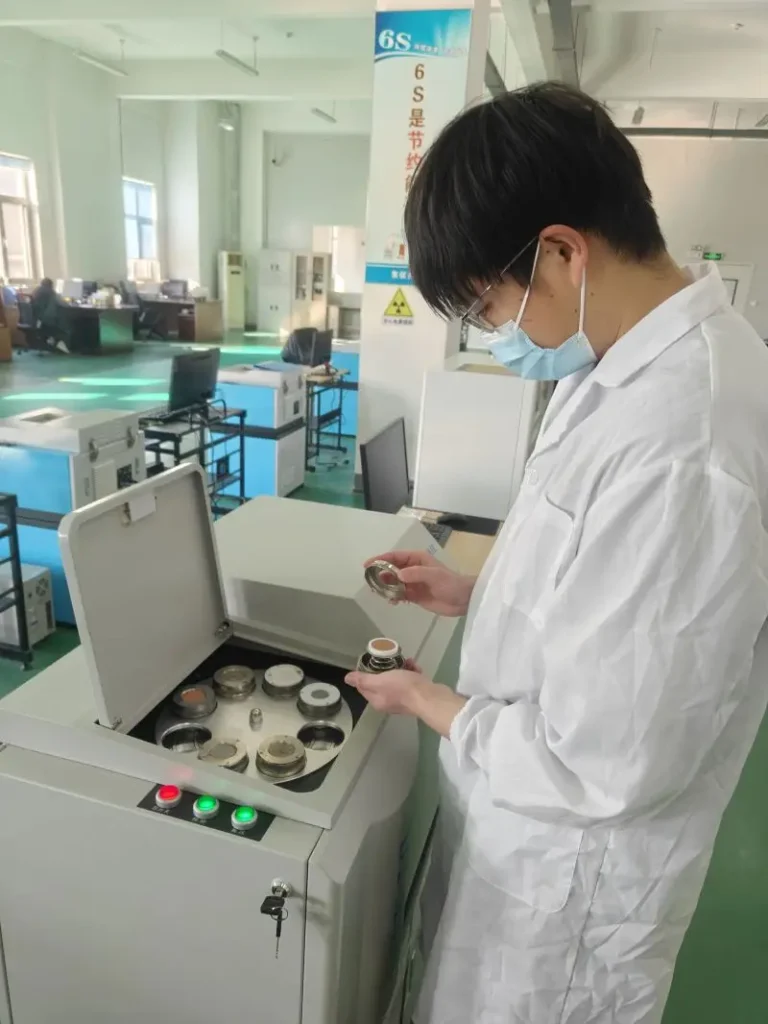
Translating theoretical frameworks into reliable, daily laboratory routines requires robust, high-performance hardware. The Maxlab suite of sample processing equipment offers a complete end-to-end solution for the challenges faced during EDXRF sample preparation.
Engineered specifically to satisfy the rigorous data-integrity standards demanded by the DFAIC model, Maxlab hardware delivers unparalleled value across three core processing phases:
Maxlab Ultra-Fine Laboratory Pulverizers
To eliminate particle size biases before attempting the pressed pellet method, Maxlab offers high-speed laboratory mills equipped with grinding sets made from ultra-hard materials like Tungsten Carbide and Chrome Steel. These units guarantee a reduction in theoretical particle size to under 50 micrometers in just a few dozen seconds, creating the ideal raw powder for compression.
Maxlab Automatic Pellet Presses
Controlling hydraulic pressure is the single most critical factor in pelletizing. Maxlab automatic presses feature digital control systems that allow technicians to program precise compression forces (up to 40 tons) and dwell times. This completely eliminates operator-induced variability, ensuring every single pellet disk possesses identical thickness, density, and surface flatness.
Maxlab Automated Sample Fusion Systems
In the fused bead method, precise temperature management and crucible agitation profiles are the secret to eliminating air bubbles and ensuring complete sample dissolution. Maxlab fusion systems utilize advanced induction or electrical resistance heating technologies to achieve real-time temperature control with a margin of error under 1°C. Automatic swirling and pouring routines ensure the seamless creation of flawless glass disks, free of micro-cracks, and ready for highly sensitive EDXRF scanning.
5. Conclusion
Optimizing your choice of EDXRF sample preparation methods is not just an auxiliary laboratory step—it is the foundational cornerstone that determines the validity of your entire XRF analysis. Depending on budget constraints and technical requirements, operations can flexibly pivot between pressed pellets and fused beads. By embedding the systematic thinking of the DFAIC framework and powering your workflow with automated preparation machinery from Maxlab, your laboratory will successfully optimize turnaround times, minimize operational costs, and consistently generate data you can trust.

