
 Tiếng Việt
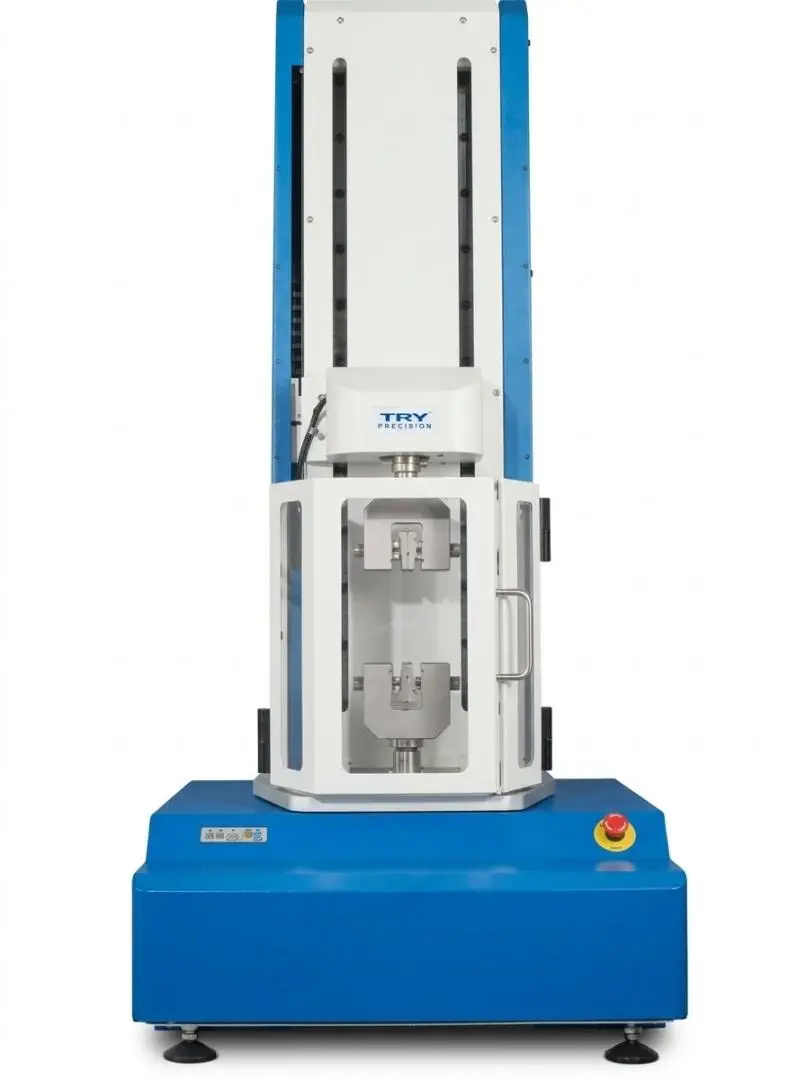
FS100 Universal Material Testing Machine
Discover the premium FS100 universal material testing machine by Maxlab. Featuring patented VPM® and DGFT® technologies and complying with ISO/ASTM standards, it offers top-tier tensile, compression, flexural, and fatigue testing for semiconductors, electronics, and advanced composites. Contact Maxlab today for expert consultation!
Product Information
FS100 Universal Material Testing Machine: A Breakthrough Quality Control Solution by Maxlab
In the era of high-tech manufacturing, ensuring the structural integrity and mechanical durability of semiconductor components, composite materials, or microelectronic circuits is a matter of survival for any business. Even a minor defect in a micro-solder joint or a tiny tear in thin-film packaging can lead to entire product batches being rejected, causing millions of dollars in damages.
To solve this rigorous quality control (QA/QC) challenge, modern laboratories require a measurement device capable of absolute precision at both macro and micro scales. Understanding this critical need, Maxlab proudly introduces the FS100 universal material testing machine—a cutting-edge technological solution designed to precisely quantify every mechanical force characteristic of your materials.
1. Overview of the Premium Universal Material Testing Machine Series
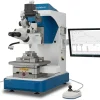
The FS100 universal material testing machine (widely recognized globally within the premium segment of Universal Material Testing Instruments) is a comprehensive force measurement system. Unlike bulky, crude industrial tensile testing machines, this system is finely tuned and engineered specifically to inspect both raw materials and finished products within standard laboratory environments.
The product features a rigid hardware frame paired with ultra-sensitive load cells and intelligent programmable control software. As a result, the machine can simulate and execute both destructive and non-destructive testing configurations across various complex geometric shapes of test specimens.
2. Comprehensive Test Profiles Executed by the FS100
What gives this system its “universal” value is the sheer diversity of its force testing applications. With a single testing frame supplied by Maxlab, enterprises can deploy a wide range of core quality evaluation methods, including:
-
- Tensile Testing: The machine pulls the specimen in opposite directions to determine ultimate tensile strength, elongation at break, and material elasticity.
- Compression Testing: Applying direct compressive force from both ends of the sample measures resistance to crushing and geometric deformation under high loads.
- Bending Testing: 3-point or 4-point flexural testing evaluates the rigidity of material bars or printed circuit boards when subjected to external bending forces.
- Stripping & Peeling Testing: Measuring the adhesion strength between thin-film layers or the peel resistance of specialized carrier tapes used in electronic component packaging.
- Creeping Testing: Evaluating how materials alter their structure or degrade in mechanical properties when subjected to a constant load over extended durations.
- Cycling Testing: Configuring continuous, repetitive tensile-compression cycles accurately simulates the actual service life of electronic and mechanical components.
3. Core Technologies Setting This Equipment Apart
To achieve micro-scale precision, the FS100 universal material testing machine integrates four of the most advanced proprietary technology platforms available today:
VPM® Perfect Vertical Positioning and Traction Technology
The greatest source of error in micro-force testing typically stems from off-axis travel alignment. The patented VPM® (Vertical Positioning & Vertical Traction Patented Technology) ensures that the machine’s driving axis always maintains an absolute vertical path. Every force applied to the specimen is transmitted parallel to the measuring axis, completely eliminating parasitic torque that distorts data.
DGFT® Intelligent Digital Closed-Loop Control Technology
The DGFT® (Intelligent Digital Closed Loop Technology) operating system acts as a high-speed responsive brain. It continuously gathers real-time force and displacement feedback at an ultra-high frequency, adjusting the motor to run smoothly without jerking, and maintaining precise loading speeds down to the millisecond.
24-Bit Ultra-High Resolution and Auto-Range Technology
For micro-solder joints on semiconductors, the destructive force required can sometimes be just a few grams. With an ultra-resolution 24-Bit analog-to-digital signal converter, the machine captures the minutest changes in force. This is paired with Auto-Range technology, which automatically detects and switches to the optimal measurement scale based on sample stiffness, removing the risk of sensor damage due to manual errors.
Specialized Software and SPC/MES System Integration
The instrument comes with specialized software featuring an intuitive user interface that directly outputs vivid force-displacement curves. Crucially, the system supports seamless, real-time data synchronization with smart factory management platforms like SPC (Statistical Process Control) and MES (Manufacturing Execution System), enabling complete digitization of the quality control workflow.
4. Practical Applications in Leading Industries
Thanks to its versatile measurement range and absolute precision, the FS100 universal material testing machine distributed by Maxlab has become an indispensable tool in major R&D laboratories and manufacturing plants:
-
- Semiconductor and Microelectronics Industry: Extensively utilized as a micro-solder joint strength and push-pull tester to measure wire bond pull strength, die shear strength, or the peel force of component packaging films.
- Medical and Pharmaceutical Field: Inspecting the tensile strength of IV tubes under pressure, sterile blister packaging peel strength, syringe needle stiffness, or capsule shell hardness to guarantee biosafety.
- Automotive and Aerospace Engineering: Testing the tensile failure points of electronic sensors, engineered plastic structural components, and heavy-duty rubber seals integrated into smart vehicle control networks.
- Advanced Materials and Technical Textiles: Analyzing the mechanical behavior and stress-strain profiles of carbon fibers, next-generation composites, and high-strength flame-retardant fabrics.
5. Why Choose Measurement Equipment from Maxlab?
While the testing instrument market offers numerous vendors, Maxlab remains the strategic partner of choice for industrial enterprises by delivering outstanding value commitments:
-
- Strict Adherence to International Standards: The material testing systems provided by Maxlab fully comply with world-renowned quality certifications and testing standards, including ISO, ASTM, BS, DIN, EN, and AFNOR. All data generated possesses universal technical validity across global supply chains.
- Fully Customized Solutions: Maxlab provides holistic engineering solutions rather than just selling standalone hardware. Our engineering team is fully equipped to design customized workholders tailored to the complex geometric constraints of your products, ensuring optimal sample clamping and test repeatability.
- Professional Technical Services: The technology transfer protocol at Maxlab includes on-site installation, periodic instrument calibration, comprehensive operator training for laboratory engineers, and a robust warranty policy backed by rapid 24-hour technical responses.
Investing in the FS100 universal material testing machine equips your business with the ultimate key to standardizing production lines, guaranteeing product reliability, and confidently expanding into international markets.
Related products
TESTING INSTRUMENT