
 Tiếng Việt
Technical Documents
What is an Optical Emission Spectrometer? Working Principle and Guide to Choosing the Right Configuration for Your Lab
19
Sep
Sep
What is an Optical Emission Spectrometer? Working Principle and Guide to Choosing the Right Configuration for Your Lab
In the metallurgy, mechanical manufacturing, and material quality control industries, accurately determining the percentage of chemical elements in metals is vital to ensuring product quality. To achieve this quickly and precisely, businesses rely on a highly specialized instrument: the Optical Emission Spectrometer.
So, what is an Optical Emission Spectrometer, how does it work, and how can businesses choose the most suitable configuration among hundreds of models on the market? Let’s explore this in detail with Maxlab Equipment in the article below.
1. What is an Optical Emission Spectrometer?
To put it simply, what is an Optical Emission Spectrometer? It is an analytical instrument used to determine the chemical composition of material samples (primarily metals and alloys) by measuring the intensity of light emitted from the sample when excited by a high-energy source.
In technical documentation, this device is commonly referred to as a spark direct-reading spectrometer, or OES (Spark Optical Emission Spectrometer). The OES analysis method is considered the gold standard in the metal industry due to its ability to simultaneously perform quantitative analysis of dozens of chemical elements—such as Iron (Fe), Carbon (C), Silicon (Si), Manganese (Mn), Phosphorus (P), Sulfur (S), and especially Nitrogen (N)—in just a few dozen seconds.
2. The Working Principle of an OES Optical Emission Spectrometer
Once you understand the basic concept of what is an Optical Emission Spectrometer, it is important to look deeper into its internal mechanism. From a physics perspective, the operation of the machine is based on electron excitation and atomic emission. This process takes place in three core steps:
- Step 1 – Electron Excitation: The machine uses an electrode and a high-voltage spark source to act directly on the surface of the metal sample. The massive energy from the spark vaporizes a tiny portion of the sample material and excites the outer-shell electrons of the metal atoms, causing them to jump to a higher energy state (excited state).
- Step 2 – Light Emission: The excited state is inherently unstable. The electrons quickly drop back down to their lower, baseline energy state (ground state). During this transition, they release their excess energy in the form of light particles (photons). Each different chemical element emits specific, characteristic light wavelengths (spectral lines).
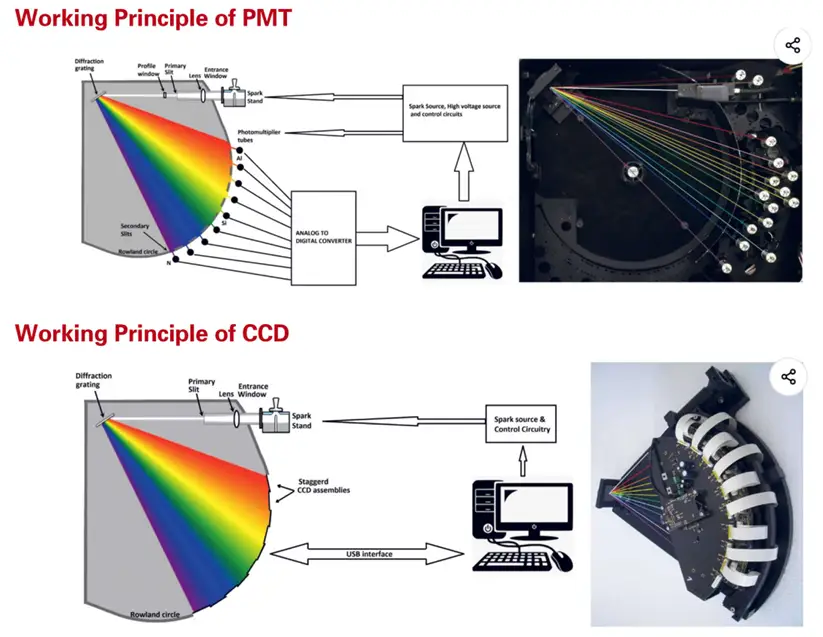
- Step 3 – Detection and Analysis: The composite light emitted from the sample passes through a system of lenses and a diffraction grating, which splits the light into individual monochromatic wavelengths. Then, a dedicated detector system measures the light intensity of each wavelength. A higher intensity indicates a greater concentration of that specific element in the sample. This data is processed by computer software to output the exact percentage of each element.
3. The Heart of the Spectrometer: Comparing PMT and CCD Detectors
When diving deep into the operation of various spectrometers, a major question that often arises alongside what is an Optical Emission Spectrometer is: Which detector technology should you choose? Currently, the two most common detector technologies integrated into the high-end OES systems of the DFAIC brand are PMT and CCD.
To provide a clear, scannable overview, Maxlab Equipment has summarized their key differences in the comparison table below:
| Comparison Criteria | PMT Detector (Photomultiplier Tube) | CCD Detector (Charge-Coupled Device) |
|---|---|---|
| Technology Nature | Photomultiplier tube (1 tube corresponds to 1 fixed element pre-installed). | Charge-coupled device (Full-spectrum analysis). |
| Detection Limit | Extremely low, reaching single-digit (below 1 PPM). | Low, typically around 10 PPM. |
| Precision & Repeatability | Very high, exceptionally stable with minimal error. | Good, highly stable for major elements. |
| Expandability | Limited. Adding new elements requires physically installing a PMT tube and complex hardware adjustments. | Highly flexible. No extra hardware cost; simply update the software to add new elements. |
| Device Size | Large (Typically a floor-standing configuration). | Compact (Typically a bench-top configuration). |
| Service Life | Outstanding durability, over 20 years. | Around 10 years. |
| Investment Cost | High, suited for premium segments. | Low to medium, offering great economic value. |
4. Comprehensive Spectrometer Solutions from the DFAIC Brand
If your business is looking for an optical emission spectrometer brand that guarantees both exceptional accuracy and a diverse range of price points, DFAIC is the perfect answer. In Vietnam, Maxlab Equipment is proud to offer advanced technological solutions from DFAIC with a product portfolio tailored to every practical need:
- Classic & Export Series (DF170, DF200): These models feature a Rowland Grating optical system combined with PMT detectors and a dedicated vacuum pump system. This is the optimal solution for independent testing labs and research institutes that require absolute precision down to parts per million (PPM) for highly challenging elements like P, S, and N.
- Economy & Universal Series (DF700, DF410): These models integrate a CCD detector with a Flat-Field Grating. Notably, the DF700 model utilizes an Argon-filled chamber instead of a vacuum pump, maximizing savings on maintenance costs. This is an efficient tool for small and medium foundries due to its lightweight design, cost-effectiveness, and fast return on investment.
- Premium & Innovative Series (DF660, DF800): A premium combination of advanced mechanical structures and next-generation CCD detectors. These systems optimize the entire optical wavelength range, delivering analytical performance that approaches PMT levels while maintaining the superior flexibility of a full-spectrum system.
5. 5-Step Guide to Choosing the Right Spectrometer Configuration from Maxlab Equipment
Understanding what is an Optical Emission Spectrometer is only the first step. To ensure the best return on your investment, procurement departments should collaborate with analytical engineers to select a machine configuration based on these 5 core criteria:
- Determine Technical Requirements (Performance): Does your business need to measure trace elements at ultra-low levels (below 10ppm) or just main elements in steel grades? If you need extreme sensitivity for trace impurities, prioritize PMT detector lines. For multi-element flexibility and general testing, CCD models from DFAIC offer better economic value.
- Evaluate Installation Space: If you have a standard laboratory with ample space, a robust floor-standing system will provide a highly professional setup. Conversely, if you need to place the unit directly on the production floor or next to a casting furnace for rapid sample testing, a compact, easy-to-move bench-top model is much better.
- Balance the Investment Budget: Carefully calculate both the initial purchase cost and ongoing operational costs (Argon gas supply, vacuum pump maintenance). A CCD-based spectrometer like the DF700 is an excellent starting point for tighter budgets, whereas premium PMT floor-standing models are suited for long-term projects with larger capital.
- Identify Nitrogen (N) Testing Needs: Nitrogen content significantly impacts the mechanical properties of certain specialty steels. Measuring Nitrogen requires a deep optical range and specialized hardware. Therefore, you must work closely with your supplier to confirm whether the specific model supports a Nitrogen analysis module.
- Consider Specialty Metal Matrices: Beyond basic matrices like Iron (Fe), Aluminum (Al), and Copper (Cu), if your business needs to analyze rare alloys, Titanium, or Cobalt alloys, be sure to request customized solutions regarding the hardware configuration from the manufacturer.
Conclusion
We hope this article has fully answered the question of what is an Optical Emission Spectrometer, while providing a clearer understanding of the core technologies like OES, PMT, and CCD that shape the material analysis industry today. Selecting a high-value asset like an optical emission spectrometer requires a deep understanding of both technical specifications and business economics.
In Vietnam, Maxlab Equipment is proud to be a trusted partner providing genuine DFAIC optical emission spectrometer solutions. We don’t just sell equipment; we deliver comprehensive solutions—ranging from configuration consulting, installation, and technology transfer to periodic maintenance and calibration services by experienced engineers. Contact Maxlab Equipment today to receive the most professional technical support for your lab!

