

 Tiếng Việt
User manual
Selecting the Ideal BGA Rework Station for PCB and SMT Manufacturing Plants: A Strategic Guide
08
Apr
Apr
In the rapidly evolving world of electronics manufacturing, the transition toward miniaturization and high-density interconnects has made the BGA (Ball Grid Array) package a standard. While BGA components offer superior electrical performance and space efficiency, they present a significant challenge when defects occur during the Surface Mount Technology (SMT) process. Unlike leaded components, BGA solder joints are tucked beneath the component body, making manual touch-ups impossible.
For a modern PCB assembly (PCBA) plant, investing in a high-quality BGA Rework Station is not just about repairs—n it is about quality assurance, waste reduction, and maintaining a competitive edge. This guide explores the critical factors for selecting the right equipment to integrate into your production line.
1. The Critical Role of BGA Rework in SMT Production
In a high-volume SMT environment, even a 99% yield rate leaves a significant number of boards requiring rework. Discarding high-value multi-layer PCBs due to a single misaligned BGA or a solder bridge is economically unsustainable.
A professional BGA rework system allows technicians to desolder, reball, and resolder components with surgical precision. By mimicking the original reflow profile of the SMT oven, these machines ensure that the thermal stress on the PCB is minimized, preserving the structural integrity of the copper traces and surrounding sensitive components.
2. Key Technical Specifications to Consider
A. Heating Technology: Hot Air vs. Infrared (IR)
The heating method is the heart of any rework station. There are three primary types used in industrial settings:
- Hot Air Systems: These use nozzles to direct heated air specifically at the BGA. They provide a highly uniform temperature distribution and are preferred for densly populated boards where you need to protect adjacent components from “heat creep.”
- Infrared (IR) Systems: IR uses light energy to heat the board. The advantage is that it doesn’t require specific nozzles for different chip sizes. However, IR can be sensitive to component color (darker surfaces absorb more heat), requiring more sophisticated sensor monitoring.
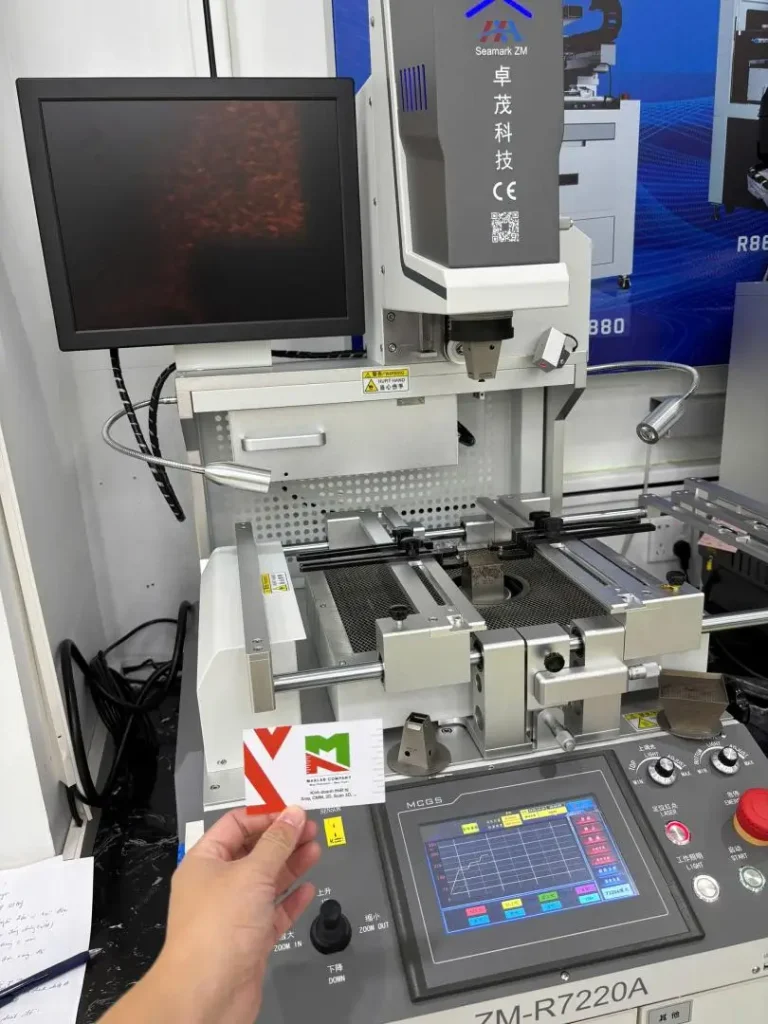
- Hybrid Systems: Many top-tier manufacturers, such as Seamark ZM or PDR, utilize hybrid technology—using hot air for the top heater and IR for the large bottom pre-heater. This is widely considered the “Gold Standard” for industrial PCB rework.
B. Precision Optical Alignment Systems
Manual placement of a BGA with hundreds of pins is prone to failure. For a manufacturing plant, a Split-Vision Optical Alignment system is mandatory. This technology uses a high-definition CCD camera and a prism to overlay the image of the BGA solder balls onto the PCB pads on a monitor. This allows the operator to align the X, Y, and Theta axes with micron-level accuracy before the machine automatically lowers the chip for soldering.
C. Multi-Zone Thermal Management
To prevent PCB warping (a common cause of “popcorning” or internal delamination), the machine must heat the board evenly. Look for a system with at least three independent heating zones:
- Top Heater: Focuses on the component.
- Bottom Heater: Directs heat to the underside of the BGA area.
- Large IR Pre-heater: Warms the entire PCB to a base temperature (e.g., 100°C–150°C) to prevent thermal shock and board bending.
D. Software and Profile Traceability
In the era of Industry 4.0, data is king. Your rework station should feature “closed-loop” temperature control with highly sensitive thermocouples. The software must be able to store hundreds of thermal profiles and, more importantly, export “Rework Reports.” This traceability is often a requirement for ISO-certified plants or those serving the medical and aerospace sectors.
3. Top Market Choices for 2026
When scouting for equipment, several brands dominate the industrial landscape:
- High-End Precision: Brands like Ersa (Germany) or PDR (UK) are renowned for their non-contact IR technology and exceptional build quality, though they come with a premium price tag.
- Industrial Workhorses: Seamark (Zhuomao) and Quick offer robust, high-performance machines (such as the ZM-R7220A or ZM-R7850A) that provide the best price-to-performance ratio for mid-to-large scale SMT factories.
- Specialized Repair: For smaller labs or mobile device specialists, companies like Honton provide reliable entry-level industrial systems.
4. Return on Investment (ROI) Analysis
While a professional BGA rework station can cost anywhere from $8,000 to $30,000, the ROI is often realized within the first 6–12 months. By successfully recovering just 5–10 high-value server boards or automotive ECU modules per month, the machine pays for itself. Furthermore, having this capability in-house reduces lead times for clients who would otherwise have to wait for third-party repair services.
Conclusion
Selecting a BGA rework station for an SMT plant is a balance between thermal precision, ease of use, and long-term reliability. By prioritizing optical alignment and multi-zone heating, your facility can ensure that “reworked” boards meet the same rigorous quality standards as those fresh off the assembly line.

