
 Tiếng Việt
User manual
Industrial X-Ray Inspection Solutions: Matching the Right Technology to Different Manufacturing Applications
08
Oct
Oct
Industrial X-Ray Inspection Solutions: Matching the Right Technology to Different Manufacturing Applications
In today’s era of smart manufacturing, stringent quality control without destroying or dismantling the end product is a make-or-break factor for industrial enterprises. Traditional Automated Optical Inspection (AOI) systems face strict limitations when dealing with hidden components, deep-seated solder joints, or complex battery layers.
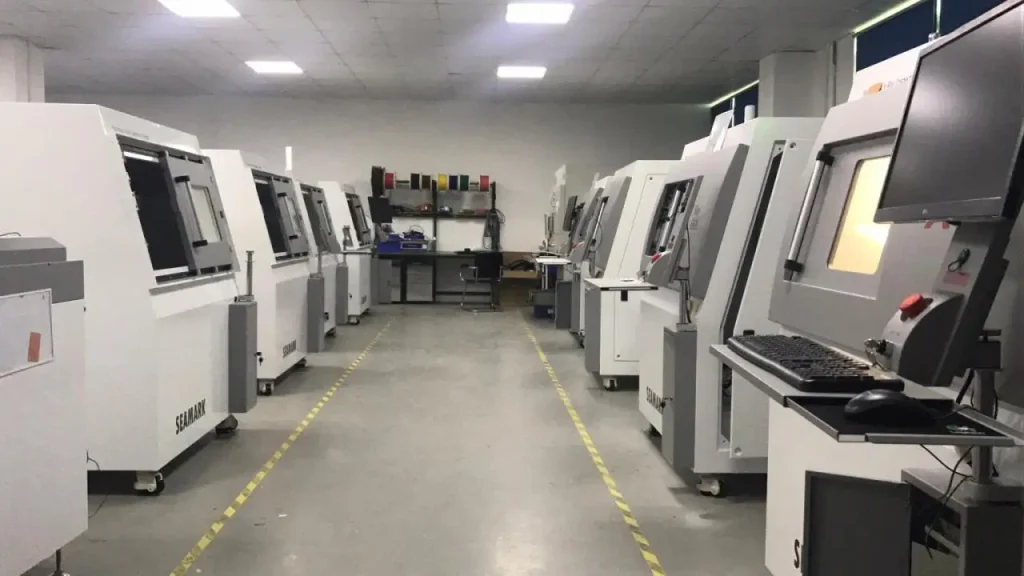
To overcome these structural roadblocks, the industrial X-ray inspection machine has emerged as a definitive breakthrough. By safely penetrating various material layers, this technology allows engineers to look inside the product and identify internal anomalies within seconds. However, because every production floor operates under unique criteria, choosing the right system architecture is far more critical than simply purchasing the highest-voltage machine available.
1. Key Industrial Applications in High-Tech Manufacturing
🔹 Electronics and PCBA Manufacturing (EMS & SMT)
High-density printed circuit board assembly relies heavily on non-destructive testing. As components continue to shrink, package types like BGAs, QFNs, and LGAs place their solder connections completely underneath the component body.
- The Challenge: Sub-surface defects such as voids, bridging, solder balls, and open joints cannot be evaluated through optical inspection.
- The X-Ray Solution: An SMT X-Ray inspection system precisely measures the voiding ratio and joint integrity. For high-volume mass production, an Inline X-Ray system integrates directly into the SMT line for real-time inspection. Meanwhile, Offline X-Ray systems offer the required flexibility for failure analysis laboratories, engineering audits, and low-volume, high-mix production.
🔹 Semiconductor Packaging & High-Power Modules
Advanced packaging trends demand sub-micron accuracy as interconnects become multi-layered and dense.
- The Application: Inspecting ultra-fine wire bonding, 3D stacked dies, wafer-level packages, and high-power modules like IGBTs and SiC semiconductors.
- The Equipment Strategy: Complex geometries benefit significantly from Industrial Microfocus 3D/CT systems (such as Seamark ZM’s AXI9000 or XCT8500). Three-dimensional computed tomography reconstructs the entire volumetric data of the sample, eliminating the overlapping point-blind spots that occur with traditional 2D planar projection imaging.
🔹 Lithium-Ion Battery Manufacturing (EV & Energy Storage)
With the rapid expansion of the Electric Vehicle (EV) supply chain, internal battery cell structural safety has become a paramount regulatory and quality concern.
- The Application: Assessing the alignment between positive (+) and negative (-) electrodes in cylindrical cells (such as 18650/4680 formats) or pouch/stacking batteries without opening the casing.
- Solutions by Seamark ZM: Dedicated series like the XB8100/XB8200 X-Ray Lithium Battery Inspection feature sealed microfocus X-ray tubes. They automate the loading, inspecting, defect-recognizing, and sorting processes directly on the automated production line, ensuring data traceability for every single cell.
🔹 Precision Casting & Automotive Components
Tier 1 and Tier 2 automotive suppliers manufacture mission-critical parts with internal cavities or joint structures. Digital radiography allows operators to identify casting discontinuities—such as blowholes, internal porosity, cracks, and inclusions—protecting factory yields before products are released to global assembly plants.
2. Direct Comparison: Inline vs. Offline X-Ray Inspection Systems
To maximize your operational Return on Investment (ROI), manufacturing managers must evaluate system architectures based on floor requirements:
| Comparison Metric | Offline X-Ray Inspection System | Inline X-Ray Inspection System |
|---|---|---|
| Operational Placement | Quality control labs, R&D centers, or next to production lines. | Integrated directly within continuous automated conveyor belts (SMT line). |
| Process Flow | Manual sample loading, parameter tuning, and software manipulation by operators. | Fully automated (AXI): Automated loading, image acquisition, defect sorting. |
| Throughput & Capacity | Low to medium. Ideal for statistical auditing, sampling, or deep failure analysis. | Very high throughput. Engineered for continuous 24/7 mass production flows. |
| Primary Use Case | High-mix, low-volume manufacturing setups and engineering laboratories. | Mass production facilities requiring 100% inspection coverage (Batteries, Automotive). |
3. Critical B2B Evaluation Criteria for Industrial Buyers
When sourcing an industrial X-ray inspection machine, engineering executives should prioritize five core performance pillars:
- Resolution and Penetration Power: The focal spot size of the microfocus X-ray tube dictates image resolution. Smaller focal spots provide sharper images of tiny features. Additionally, the tube voltage (kV) must match the density and thickness of your workpiece.
- Radiation Safety Compliance: Ensure the cabinet X-ray enclosure complies with international standards, such as IEC 61010-2-091:2019. Local regulatory licensing and radiation safety paperwork must be fully supported by the provider.
- AI Automation & Software Intelligence: Look for advanced software features like Automated Defect Recognition (ADR) and automatic voiding ratio calculation. This minimizes human classification errors and operator fatigue.
- MES Integration & Data Traceability: The machine software must seamlessly communicate with your factory Manufacturing Execution System (MES) to store inspection images, data logs, and defect classifications for future quality retrieval.
4. Why Partner Directly with Seamark ZM Factory?
Sourcing your equipment directly from an original manufacturer like Seamark ZM Technology delivers engineering advantages that trading companies cannot match:
- Application-Specific Customization: Seamark’s technical teams can adapt mechanical conveyor dimensions, design specialized component fixtures, or modify AI inspection algorithms to fit your precise product specifications.
- Comprehensive Inspection Portfolio: Access a complete ecosystem ranging from standard SMT board inspectors (X5600, X6600) to automated X-ray reel counters (XC1000, XC2000) that reduce warehouse component counting labor costs by up to 70%.
- Direct Factory Engineering Support: Minimize manufacturing downtime with factory-backed maintenance, X-ray source/detector calibration, and proactive software upgrades, ensuring maximum machine uptime for your factory.
READY TO UPGRADE YOUR FACTORY QUALITY ASSURANCE?
Stop guessing what is happening inside your products. Contact the Seamark ZM’s distributor engineering team today to review your technical drawings, arrange a complimentary Sample Testing session, and receive an official quote.

