

 Tiếng Việt
Technical Documents
In-Depth Comparison: HR-150B vs. HRD-150B Veiyee Hardness Testers – Manual or Motorized?
22
Jul
Jul
In-Depth Comparison: Veiyee HR-150B vs. HRD-150B Hardness Testers – Manual or Motorized?
When searching for a reliable Rockwell hardness testing solution for heavy-duty mechanical parts, thick cast molds, or elongated shafts, the Veiyee brand is consistently the top choice among engineers. This reputation is built on their specialized heightened machine chassis, which expands the vertical testing space up to 400mm.
In this specific segment, two models—the HR-150B and HRD-150B—often leave businesses wondering which one to choose. Universally, both machines share the identical heavy-duty casting frame, 400mm throat capacity, and standard testing scales (HRA, HRB, HRC). However, their core difference lies in their operational mechanism and test force control.
Let us dive deep into the technical comparison with Maxlab Equipment to discover the optimal choice for your production floor.
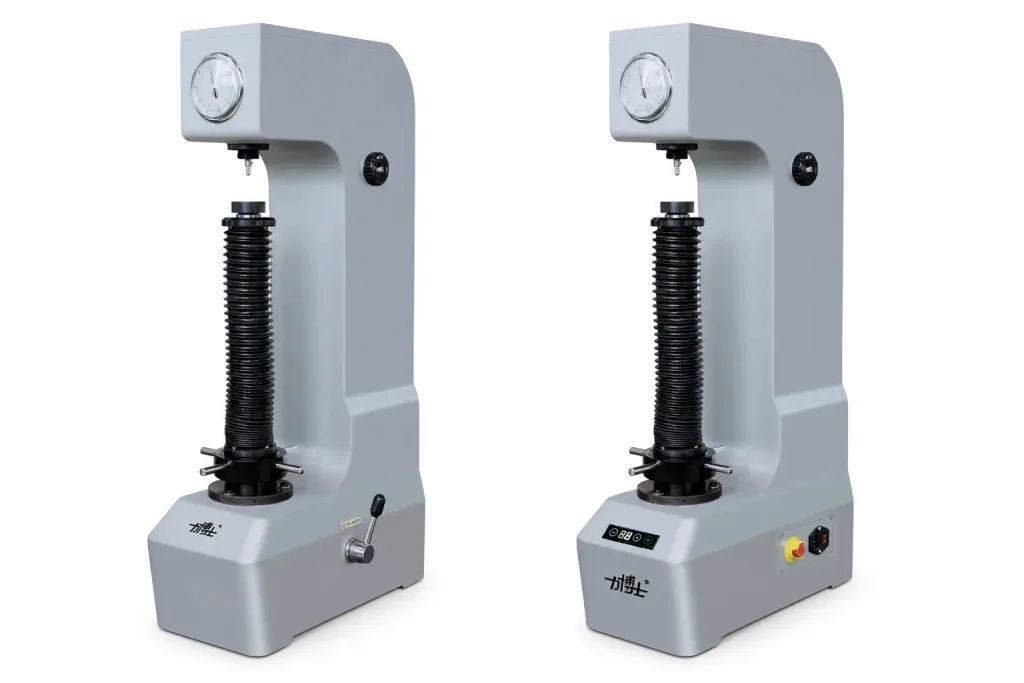
HR-150B HRD-150B
1. Operating Mechanism: Manual Lever vs. Motor-Driven Automation
This is the most critical distinction, directly impacting user experience, operator fatigue, and daily throughput.
- Veiyee HR-150B (Purely Mechanical): This model relies entirely on a mechanical lever system. After elevating the screw spindle to bring the workpiece into contact with the indenter, the technician must manually pull a side lever to initiate the loading and unloading cycle. The speed of the deadweight application is regulated by a built-in oil-based hydraulic dashpot.
- Veiyee HRD-150B (Semi-Automatic Motor-Driven): The letter “D” stands for Electric/Motor-driven, representing an internal electric motor integration. The entire sequence—loading, dwelling, and unloading—is executed automatically by the motor. The user simply sets the dwell time and presses the start button; the machine handles the indentation stroke without requiring any physical force.
2. Accuracy and Human Error Mitigation
In precision metrology, the human factor remains the leading cause of poor repeatability and measurement discrepancies.
- Model HR-150B: Because it relies on manual lever operation and the stability of a hydraulic dashpot (whose oil viscosity can subtly shift with workshop ambient temperatures), small deviations may occur between tests if different technicians pull the lever too quickly or too slowly.
- Model HRD-150B: Powered by a motorized system and electronic control board, the dwell time is regulated down to the exact second. The test force is applied with 100% uniformity across every single cycle. This completely eliminates human inertia or sudden jerks, providing superior repeatability and data reliability.
3. Working Environment and Component Durability
Every structural design is tailored to withstand specific environmental conditions on the factory floor.
- Model HR-150B (“Bulletproof” Durability): This machine requires zero electricity to operate. This makes the HR-150B the absolute “king” of harsh machining shops, foundries, and heat treatment facilities—places characterized by heavy metallic dust, high humidity, or unstable power grids. It is incredibly robust, with no delicate electronics that could malfunction.
- Model HRD-150B (Power-Dependent): This machine must be connected to a standard 220V AC power supply to drive the motor and power the internal control board. Consequently, it is better suited for material testing laboratories, climate-controlled QA/QC rooms, or cleaner production zones to maximize the lifespan of its electronic components.
4. Testing Speed and Operational Throughput
- Model HR-150B: Pulling the lever manually and waiting for the mechanical discharge takes more time. If an inspector needs to test hundreds of large workpieces daily, manual operation will inevitably lead to fatigue and a drop in overall productivity.
- Model HRD-150B: The push-button automation drastically frees up labor. The time required to complete a single measurement cycle is significantly shorter, making it perfect for high-density, batch-quality inspections on active assembly lines.
Technical Comparison Matrix
| Feature | Veiyee HR-150B | Veiyee HRD-150B |
|---|---|---|
| Power Supply | None Required | 220V AC |
| Loading Cycle | Manual (Hand Lever) | Automatic (Push Button) |
| Repeatability | Stable (Operator Dependent) | Highly Precise (Motor-Controlled) |
| Display Type | Analogue Dial Indicator | Analogue Dial Indicator |
| Optimal Environment | Heavy Machining, Harsh Workshops | QA Labs, Clean Industrial Zones |
Maxlab Equipment Recommendation: Which One Is Best for You?
- Choose the Veiyee HR-150B if: Your business wants to optimize the initial investment cost, intends to place the machine directly in a rough production environment, runs moderate testing frequencies, and prefers a purely mechanical asset that is easy to maintain without worrying about electrical faults.
- Choose the Veiyee HRD-150B if: Your factory enforces strict standards regarding data repeatability for outgoing quality reports, handles large volumes of large-scale parts daily, and aims to eliminate human errors during quality checks.
Both of these exceptional high-travel Rockwell hardness testers are available at Maxlab Equipment, complete with quality certifications (CO/CQ) and official factory warranties.
If you would like to discuss your specific workpiece dimensions or require a detailed quote comparing both models, please contact Maxlab Equipment today for immediate technical assistance!

