
 Tiếng Việt
Company Information
COMPREHENSIVE RoHS 1.0 AND RoHS 2.0 TESTING SOLUTIONS FOR LAB, R&D, AND QA/QC – MAXLAB & CONOMA PARTNERSHIP
26
Sep
Sep
COMPREHENSIVE RoHS 1.0 AND RoHS 2.0 TESTING SOLUTIONS FOR LAB, R&D, AND QA/QC – MAXLAB & CONOMA PARTNERSHIP
In today’s strictly regulated global supply chain, controlling hazardous substances in electrical and electronic products is no longer a voluntary certification—it is a mandatory passport to global markets. For testing Labs, R&D departments, and QA/QC teams at manufacturing plants, equipping a highly accurate and synchronized RoHS compliance testing machine is a top priority.
To deliver advanced technology solutions alongside factory-certified technical services, Maxlab Equipment Company has established a strategic partnership with Conoma—a leading brand in analytical instrumentation. Together, we provide an optimized product portfolio that fully satisfies both RoHS 1.0 and RoHS 2.0 standards.
1. Differentiating the Scope of RoHS 1.0 vs. RoHS 2.0 Testing
To build a rigorous testing workflow in your Lab or QA/QC line, businesses must first clarify their analytical goals based on the distinct requirements of the two regulatory generations:
- RoHS 1.0 Standard: Limits the concentration of 6 core hazardous substances, primarily heavy metals and flame retardants: Lead (Pb), Mercury (Hg), Cadmium (Cd), Hexavalent Chromium (Cr⁶⁺), Polybrominated Biphenyls (PBB), and Polybrominated Diphenyl Ethers (PBDE).
- RoHS 2.0 Standard: Introduces stricter compliance by adding 4 plasticizers (Phthalates) commonly found in plastics, rubbers, and cables: DEHP, BBP, DBP, and DIBP. This expansion brings the total number of restricted substances to 10, forcing R&D departments to upgrade from fast screening to deep quantitative organic analysis.
2. Comprehensive RoHS Compliance Testing Machines from Conoma
Conoma offers a diverse ecosystem of analytical instruments, perfectly covering everything from rapid on-site screening to deep laboratory testing.
XRF Technology (RoHS 1.0 Testing) – Fast Screening for QA/QC
For incoming and outgoing quality control (QA/QC) departments, time-efficiency and sample integrity are critical.
- The Solution: Conoma’s line of RoHS compliance testing machines powered by XRF technology (RoHS 1.0 testing).
- Advantages: The X-ray Fluorescence (XRF) method enables rapid screening of heavy metals (Pb, Cd, Hg, Cr) as well as Total Bromine (Br) and Total Chlorine (Cl) within minutes. The process is completely non-destructive, making it ideal for high-frequency testing right on the production floor.
HPLC Technology (RoHS 2.0 Testing) – Precise Organic Compound Quantification
When looking closely into organic additives and newly restricted plasticizers under the updated directive, conventional spectrum analysis is no longer enough.
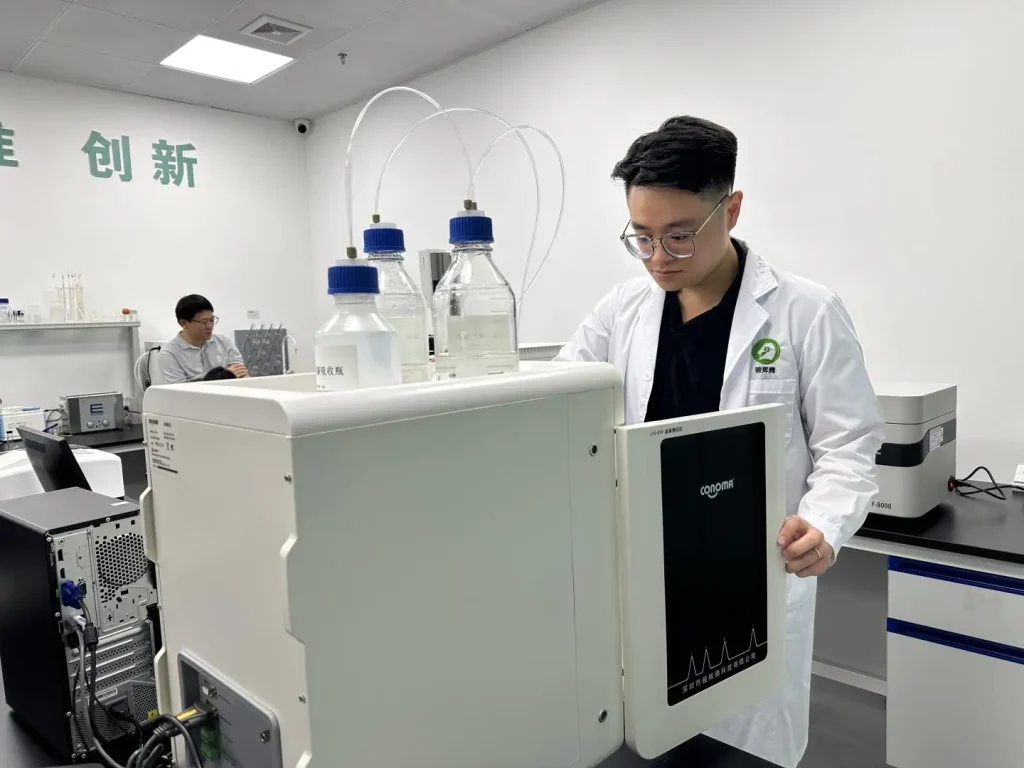
- The Solution: Conoma’s HPLC system (RoHS 2.0 testing).
- Advantages: High-Performance Liquid Chromatography (HPLC) offers exceptional separation capabilities. It accurately qualifies and quantifies individual Phthalate compounds within complex polymer matrices, providing vital data for R&D teams during new material validation.
GC-MS Technology (RoHS 2.0 Testing) – The “Gold Standard” for Labs & R&D
For third-party testing Labs, research institutes, or compliance audits that demand the highest legal and scientific validity, gas chromatography-mass spectrometry is indispensable.
- The Solution: The high-end GC-MS system (RoHS 2.0 testing) developed by Conoma.
- Advantages: This system combines the separation power of gas chromatography with the definitive identification capabilities of a mass spectrometry detector. Conoma’s GC-MS (RoHS 2.0 testing) equipment features an ultra-low limit of detection (LoD) and extreme sensitivity, smoothly processing volatile organic compounds to ensure maximum compliance with international regulations.
3. Maxlab Enhances Technical Excellence with Intensive Training at Conoma (Shenzhen, China)
Going beyond equipment distribution, Maxlab commits to mastering the technology to provide long-term, reliable support to our clients. Recently, the application engineers and technical specialists of Maxlab Equipment Company successfully completed an intensive hands-on training program at the headquarters of Conoma in Shenzhen, China.
At Conoma’s core R&D facility, Maxlab engineers actively engaged in:
- Advanced operation and software optimization for XRF (RoHS 1.0 testing), HPLC (RoHS 2.0 testing), and GC-MS (RoHS 2.0 testing) systems.
- Factory-standard calibration techniques, preventative maintenance, and hardware troubleshooting to match strict factory guidelines.
- Analyzing complex sample matrices (such as recycled plastics and multi-layered integrated components) to address practical challenges faced by FDI enterprises in Vietnam.
This direct technology transfer in Shenzhen is Maxlab’s strong promise to the market: We do not just sell a RoHS compliance testing machine; we deliver complete technical solutions, professional warranty services, and 24/7 factory-certified support.

