

 Tiếng Việt
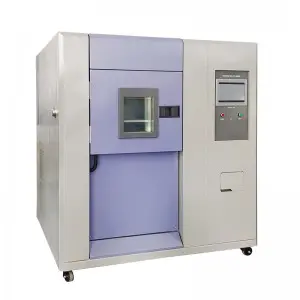
THERMO SHOCK TEST CHAMBER
A Thermal Shock Test Chamber is a specialized environmental testing machine designed to evaluate product durability by exposing samples to extremely rapid and sudden changes in temperature.
Unlike standard temperature chambers that change conditions gradually, a thermal shock chamber can transition a test subject between extreme heat and extreme cold within
Product Information
1. How It Works
These chambers are typically divided into separate zones maintained at extreme high and low temperatures:
- Two-Zone (Elevator Type): The test sample is placed in a motorized basket that moves vertically between a hot chamber and a cold chamber.
- Three-Zone: The sample remains stationary in a center “test zone.” Damper valves alternate the flow of pre-heated or pre-cooled air into the test zone.
- Liquid-to-Liquid: The sample is mechanically dipped into baths of different liquids. This provides the fastest possible heat transfer and is used for the most rigorous military and aerospace standards.
2. Purpose of the Test
The primary goal is to induce thermal stress to reveal hidden design or manufacturing flaws that standard tests might miss, such as:
- Material Cracking: Due to mismatched thermal expansion rates between different materials.
- Solder Joint Failure: Particularly in PCB assemblies where micro-cracks can form under stress.
- Seal Leaks: Identifying failures in gaskets or hermetic seals.
- Coating Delamination: Checking if paints or protective coatings peel off during rapid temperature swings.
3. Key Features in 2026
In 2026, thermal shock technology has advanced to meet the high-reliability demands of the electric vehicle (EV) and 5G infrastructure sectors:
- Energy Recovery Systems: Modern 2026 models utilize heat exchange technology to reuse energy between the hot and cold zones, significantly reducing electricity costs.
- AI-Enhanced Control: Controllers now use AI algorithms to prevent “temperature overshoot,” ensuring the sample reaches the exact target temperature faster without exceeding safety limits.
- Sustainability: Following 2026 environmental mandates, chambers use ultra-low GWP (Global Warming Potential) refrigerants to minimize their carbon footprint.
4. Common Applications
- Semiconductors & Electronics: Testing the reliability of microchips, sensors, and 5G modules.
- Automotive: Evaluating EV battery management systems (BMS) and engine sensors that face extreme heat cycles.
- Aerospace: Testing components that must endure the transition from sea-level heat to the freezing temperatures of high altitude.
- Defense: Ensuring military hardware remains operational in the world’s most hostile climates.
Be the first to review “THERMO SHOCK TEST CHAMBER”
Related products
ENVIRONMENT CHAMBER
ENVIRONMENT CHAMBER
ENVIRONMENT CHAMBER
ENVIRONMENT CHAMBER






Reviews
There are no reviews yet.