

 Tiếng Việt
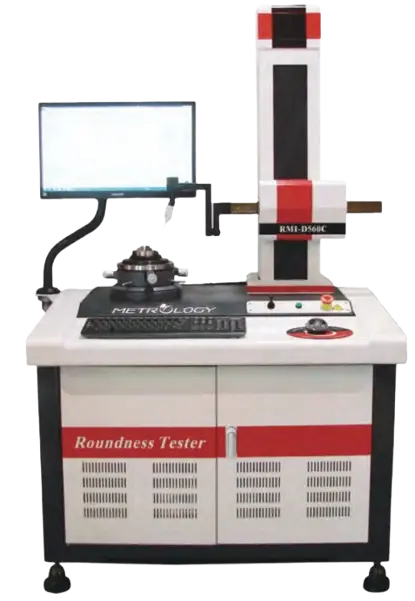
Roundness Tester
A Roundness Tester (also known as a Circularity Measuring Machine) is a specialized metrology instrument designed to measure the geometric form and precision of rotating parts. While a micrometer can measure diameter, a roundness tester evaluates the radial variation of a part’s surface relative to a fixed center point to ensure it is perfectly circular.
Product Information
How It Works
The machine uses a high-precision spindle to rotate either the workpiece or the measuring probe.
- Rotation: The part is placed on a rotating table (Turntable type) or a probe rotates around the fixed part (Rotating Stylus type).
- Contact/Sensing: A sensitive stylus maintains contact with the surface. As the part rotates, the stylus moves in and out based on surface irregularities.
- Data Analysis: The sensors convert this movement into a digital profile. The software applies mathematical filters (like the Least Squares Circle – LSC method) to calculate the deviation from a perfect circle.
Key Parameters Measured
- Roundness (Circularity): The deviation of the profile from a perfect circle.
- Cylindricity: Extending roundness measurements along the entire length of a cylinder to check for tapering or bowing.
- Concentricity/Coaxiality: Measuring how centered two or more circles are relative to each other.
- Run-out: Measuring the total variation of a surface as the part is rotated 360°.
Key Features in 2026
- AI-Driven Alignment: New 2026 models from Mitutoyo and Taylor Hobson feature Automatic Centering and Leveling (ACL). Using AI, the machine automatically aligns the part in seconds, a task that used to take technicians several minutes.
- Sub-Micron Precision: Modern spindles now achieve rotational accuracies of less than 0.02 µm, essential for the tight tolerances of high-tech manufacturing.
- Multi-Sensor Capability: Some 2026 systems combine tactile probes with non-contact optical sensors to measure delicate surfaces without scratching them.
Common Applications
- Automotive: Inspecting engine pistons, crankshafts, and fuel injector needles to reduce friction and noise.
- Aerospace: Verifying the precision of jet engine bearings and turbine shafts where even a micron of error can cause catastrophic failure.
- Medical: Ensuring the roundness of prosthetic hip joints and surgical tools.
- Bearing Industry: Critical for high-speed ball bearings to ensure smooth rotation and long life.
Why It Is Essential
In advanced manufacturing, a part might have the correct diameter but be “triangular” or “oval” in shape (known as lobing). A Roundness Tester is the only way to detect these lobing effects, which can cause vibrations, heat, and premature wear in mechanical systems.
Be the first to review “Roundness Tester”
Related products
CONTOUR MEASURING MACHINE







Reviews
There are no reviews yet.