
Tin tức
Differences in Accuracy and Applications Between Profile Projectors and Video Measuring Machines
Dec
At first glance, both systems are optical instruments for 2D inspection, but anyone with hands-on manufacturing experience knows they serve very different purposes. Each has its own strengths and limitations.
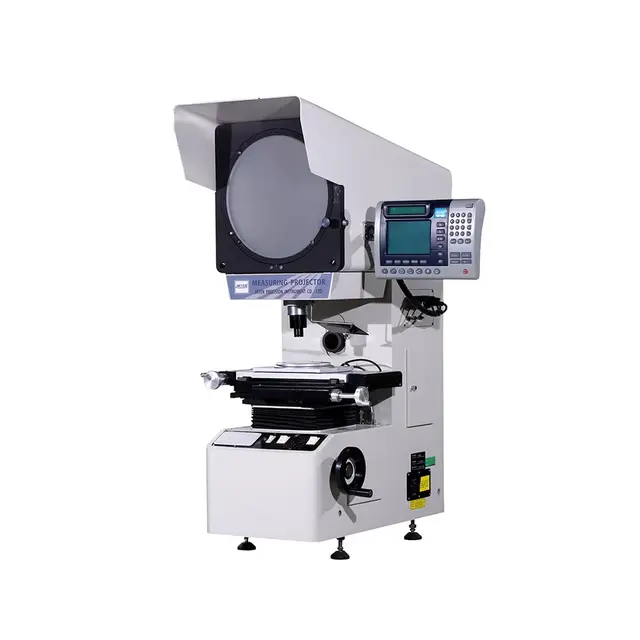
The profile projector was one of the first optical inspection tools I ever used. Over 20 years ago, while supporting a tooling factory, I often saw operators using profile projectors to inspect stamped parts. Small components placed on the stage could be magnified dozens of times on the screen, helping users quickly identify deformation or burrs. For thread inspection, projectors are also highly effective—the thread angle of screws or lead screws is nearly impossible to judge with the naked eye, but when enlarged, it can be evaluated immediately and accurately. Gear manufacturers rely on projectors to compare tooth profiles against standards, which is sufficient for daily inspection. In cutting tool inspection, profile projectors are almost indispensable. I’ve seen tools that looked sharp to the naked eye but revealed micro-chips when magnified. Using such tools in production would quickly lead to surface defects. The visual clarity provided by profile projectors addresses these challenges effectively.
As manufacturing evolved, video measuring machines (VMMs) gradually became mainstream. Unlike projectors, VMMs use high-resolution cameras and software to capture and analyze profiles. The process does not rely on operator interpretation, resulting in greater stability and repeatability. A few years ago, I visited a smartphone component factory where tolerances were within a few microns. Manual inspection couldn’t ensure consistency, but with VMMs, dozens of dimensions were measured simultaneously and reports were generated automatically. In PCB manufacturing, where boards contain countless pads and micro-holes, projectors cannot handle the complexity, while VMMs easily perform batch inspection. In medical device production, I’ve seen VMMs used to inspect syringes and stents, ensuring dimensional accuracy and providing traceable reports to meet stringent regulatory requirements.
Despite the higher accuracy and automation of VMMs, profile projectors retain their value. Many factories use both. On the production floor, operators often prefer projectors for quick checks—simple, intuitive, and efficient. In the quality department, VMMs are used for final verification to ensure traceable results that meet customer requirements. For example, in a cutting tool plant, operators use projectors to check cutting angles, then use VMMs to confirm final dimensions before shipment. This two-step workflow balances efficiency and precision.
From my experience, there is no single “best” instrument for all scenarios. Profile projectors are cost-effective, reliable, and easy to operate—ideal for routine inspection. VMMs offer high accuracy, automation, and are suitable for mass production or strict quality systems. For many companies, combining both often delivers the most optimized measurement value.