

 Tiếng Việt
User manual
Which Handheld Spectrometer Should You Buy? Comparing XRF DF-2000 and LIBS DF-900
14
Jun
Jun
Which Handheld Spectrometer Should You Buy? Comparing XRF DF-2000 and LIBS DF-900
In the modern industrial sector, rapidly and accurately identifying the elemental composition of materials directly on-site is a critical factor for successful quality control. To solve this operational challenge, investing in a portable handheld spectrometer has become an absolute necessity for modern manufacturing plants, scrap yards, and remote mining sites.
Among the most reputable manufacturers, Yantai Dongfeng (Shandong Dongyi Photoelectric Activity Group) stands out with two flagship products representing the two most dominant analytical technologies available today: the model DF-2000 (XRF technology) and the model DF-900 (LIBS technology). Which model should your business invest in? This in-depth article analyzes both devices to help you make an accurate, cost-effective purchasing decision.
1. Understanding the Core Technologies of a Handheld Spectrometer
Before moving forward with a final purchase, businesses must clearly distinguish between the technical principles driving each type of handheld spectrometer:
Model DF-2000 – X-ray Fluorescence (XRF) Technology
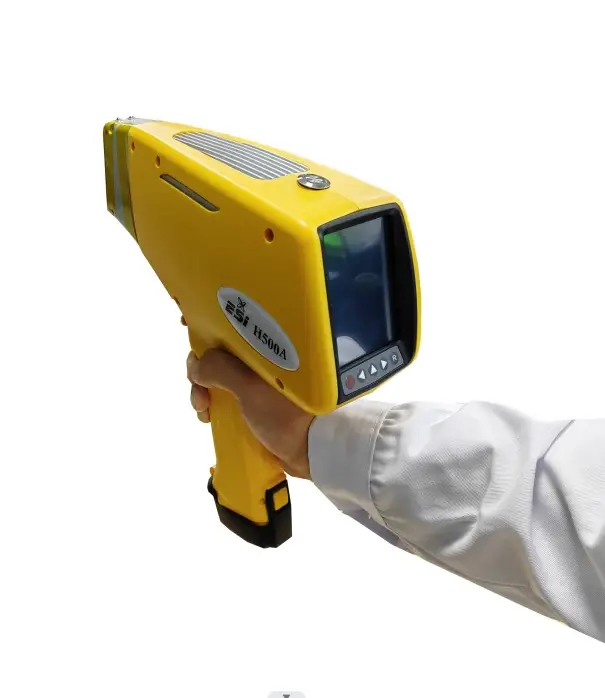
The DF-2000 is a portable handheld spectrometer that operates by emitting a controlled beam of X-rays onto the surface of a target sample. The elements within the material absorb this energy and emit secondary, characteristic fluorescent X-rays. The device captures and processes these signals to identify and quantify the material composition.
- Key Advantage: This is a 100% non-destructive testing (NDT) method. The tested sample suffers absolutely no alterations to its physical appearance, structural integrity, or chemical makeup.
Model DF-2000 – Laser-Induced Breakdown Spectroscopy (LIBS) Technology
Conversely, the model DF-900 is a handheld spectrometer utilizing high-energy laser excitation. When the operator pulls the trigger, the instrument fires a high-intensity laser pulse that vaporizes a microscopic portion of the sample surface. This process creates a tiny plasma plume (micro-destruction on a micrometer scale). The built-in spectrometer then reads the light emitted by this plasma to calculate the exact elemental percentages.
2. Detailed Comparison: Model DF-2000 vs. Model DF-900
To give you the most straightforward, practical overview before selecting your next handheld spectrometer, let let us look at how these two devices compare across critical technical specifications:
| Comparison Criteria | Model DF-2000 (XRF Technology) | Model DF-900 (LIBS Technology) |
|---|---|---|
| Excitation Source | Miniature X-ray Tube | High-Energy Pulsed Laser |
| Data Processing Speed | 10 to 30 seconds per test | Ultra-fast: 1 to 3 seconds per test |
| Carbon (C) Detection | Not possible (Blind to ultra-light elements) | Excellent (Accurately measures C content) |
| Heavy Metal Accuracy | Exceptionally high; excellent ppm-level stability | Moderate (Prone to matrix effects) |
| Sample Surface Prep | Minimal requirement; reads light oxide layers | Strict; surface must be clean, flat, and bare |
| Operator Safety Protocols | Strict regulatory compliance for X-ray radiation | Requires dedicated laser safety eyewear |
3. Choosing Your Handheld Spectrometer Based on Practical Applications
There is no single handheld spectrometer that acts as a universal cure-all for every material application. The best model choice depends entirely on your target materials and specific industry compliance goals.
When to Choose the Model DF-900 (LIBS)
If your company specializes in high-precision metal machining, boiler fabrication, high-pressure pipeline installation, or premium scrap metal recycling, the DF-900 is your optimal choice.
The defining commercial feature of this LIBS-based handheld spectrometer is its native ability to analyze the element Carbon (C). This specific capability allows engineers to instantly separate different carbon steel grades (low, medium, high carbon) and distinguish between critical stainless steel variants like Stainless Steel 304 and 304L (which only differ marginally in their Carbon percentages). Additionally, its 1-to-3-second testing speed is invaluable for sorting thousands of scrap alloy pieces in fast-paced warehouses.
When to Choose the Model DF-2000 (XRF)
On the other hand, the XRF-based handheld spectrometer DF-2000 asserts absolute superiority if your workflows demand deep, trace-level precision and exceptional repeatability for heavy metals and transition elements.
Your business should prioritize the DF-2000 for these specific applications:
- RoHS Compliance & Consumer Environmental Screening: Rapidly screens and accurately quantifies hazardous heavy metals like Lead (Pb), Mercury (Hg), and Cadmium (Cd) in electronic parts, plastics, and export toys.
- Geology, Exploration, and Mining: Measures grades of copper, iron, or precious ores directly at the mining face with supreme stability, skipping the long turnaround times of sending samples back to a laboratory.
- Precious Metals & Jewelry Hallmarking: Instantly determines the exact karat value and purity of Gold (Au), Silver (Ag), and Platinum (Pt) without causing even a microscopic scratch on valuable retail jewelry pieces.
4. Conclusion
Securing the correct handheld spectrometer saves your business significant long-term operational costs while protecting your product quality standards. If rapid sorting speed and Carbon detection for steel grading are mandatory for your yard, choose the DF-900 LIBS. If you require absolute precision for heavy metals, mining ores, or non-destructive RoHS compliance testing, the DF-2000 XRF represents the ultimate portable solution.