

 Tiếng Việt
User manual
Manual SMD Counter vs. Seamark XC1000 Auto X-Ray SMD Counter: Which is the Smarter Investment?

12
Apr
Apr
Manual SMD Counter vs. Seamark XC1000 Auto X-Ray SMD Counter: Which is the Smarter Investment?
In the fast-paced world of Surface Mount Technology (SMT) manufacturing, inventory accuracy is the backbone of operational efficiency. Discrepancies in component counts can lead to costly line stops, wasted labor, and delayed shipments. As factories move toward Industry 4.0, a critical debate arises: Should you stick with the traditional Manual SMD Counter or upgrade to an Auto X-Ray SMD Counter, such as the industry-leading Seamark XC1000?
This article provides an in-depth comparison of these two technologies to help you determine which solution fits your production scale and long-term goals.
1. Understanding Manual SMD Counters (The Traditional Way)
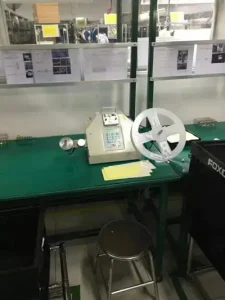
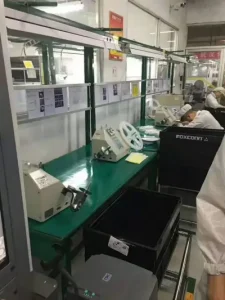
A manual or semi-automatic SMD counter operates on optical or mechanical sensor principles. The reel must be mounted on a feeder, and the carrier tape is pulled through a sensor head. The machine counts the components by detecting the sprocket holes or using an optical eye to spot the components themselves.
- The Workflow: Requires a technician to manually load the reel, thread the tape, wait for the winding process to complete, and then rewind the tape back onto the original reel.
- The Limitations: It is a physical process. If the tape is damaged or if the components are missing from the pockets (empty pockets), basic manual counters might miscount. Furthermore, it is restricted to components already taped and reeled.
2. Introducing the Seamark XC1000 Auto X-Ray SMD Counter
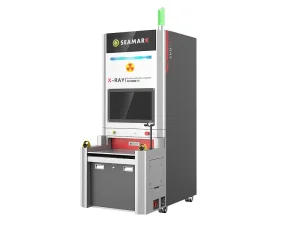
The Seamark XC1000 represents a paradigm shift in component counting. Instead of physical movement, it uses high-resolution X-ray imaging combined with Artificial Intelligence (AI) to “see” through materials.
- The Workflow: The operator simply places the reel (or multiple reels) into the machine’s drawer. The X-ray source emits radiation that penetrates the packaging, and a digital detector captures the image. The software then counts every single chip in seconds.
- Capabilities: It handles 7″ to 15″ reels, JEDEC trays, and even loose components or cut tapes.
3. Head-to-Head Comparison: Manual vs. Seamark XC1000
| Feature | Manual SMD Counter | Seamark XC1000 (X-Ray) |
|---|---|---|
| Counting Speed | 3–5 minutes per reel | < 10 seconds per reel |
| Accuracy Rate | ~98% (prone to human/tape error) | > 99.9% (AI-powered precision) |
| Labor Intensive | High (1 person per machine) | Low (1 person can manage multiple) |
| Component Safety | Risk of ESD and physical damage | Non-contact, Zero physical risk |
| Data Integration | Manual entry into ERP/MES | Automatic API/MES synchronization |
| Counting Loose Items | Impossible | Fully Supported |
4. Key Advantages of Upgrading to the Seamark XC1000
Exponential Increase in Productivity
Time is money in SMT assembly. A manual counter requires the tape to be physically wound and unwound. For a large warehouse receiving 500 reels a day, manual counting is a bottleneck that requires a large team. The Seamark XC1000 can count four 7-inch reels simultaneously in under 15 seconds. This allows one operator to do the work of five, significantly reducing overhead costs.
Preserving Component Integrity (ESD & MSD Safety)
One of the hidden costs of manual counting is the compromise of component quality. To use a manual counter, you must often break the vacuum-sealed Moisture Barrier Bag (MBB). This exposes sensitive components (MSL items) to humidity and potential Electrostatic Discharge (ESD) during the winding process.
The XC1000 counts directly through the sealed bag. This ensures that the components remain in a factory-perfect state, extending floor life and reducing the risk of “popcorning” during reflow soldering.
The XC1000 counts directly through the sealed bag. This ensures that the components remain in a factory-perfect state, extending floor life and reducing the risk of “popcorning” during reflow soldering.
Advanced AI and “Deep Learning
The Seamark XC1000 isn’t just a camera; it’s an intelligent system. Its AI algorithms are trained to recognize various component types, from 01005 passives to complex BGA and IC chips. It can even detect “empty pockets” within a reel—something manual counters often struggle with. This level of detail ensures that your ERP system reflects the actual quantity, not just an estimate.
Seamless Smart Factory Integration
The XC1000 is built for the “Smart Factory.” It features an automatic label printing system and can communicate directly with your Warehouse Management System (WMS) or Manufacturing Execution System (MES). Once the count is finished, it prints a new barcode with the updated quantity, eliminating human data-entry errors which are the leading cause of inventory “ghost stocks.”

5. Return on Investment (ROI) Analysis
While the initial cost of a Seamark XC1000 is higher than a manual counter, the ROI is typically achieved within 6 to 12 months for medium-to-large-scale manufacturers.
- Labor Savings: Reduction of 70-80% in warehouse staff hours.
- Accuracy Savings: Eliminates “line-down” situations caused by unexpected component shortages.
- Quality Savings: Reduces scrap caused by ESD or humidity exposure during manual counting.
6. Conclusion: Which is Right for You?
The Manual SMD Counter is a viable tool for small-scale prototyping shops or hobbyist labs where volume is negligible and time is not a critical factor.
However, for professional EMS (Electronic Manufacturing Services) providers and high-volume OEMs, the Seamark XC1000 Auto X-Ray Counter is no longer a luxury—it is a necessity. It provides the speed, precision, and data connectivity required to stay competitive in a global market. By choosing Seamark, you are not just buying a machine; you are implementing a sophisticated inventory control system that guarantees production continuity.

